
How I Took My Research to the Next Level: My Experience with Patenting and 3D Software Demo on SolidWorks CGM Engine

Updated: Apr 17, 2025
Started developing my own 3D software and decided I needed to check how deep the rabbit hole goes. In this post, I will share my journey through the patent application process and how I effectively used Dassault Systèmes' Spatial CGM 3D Engine to create a demo that showcased my research.
Why Patent Application Anyway?
Patents are good for corporations full of money to waste on endless legal processes and charlatans who want to "sell the innovative idea" without developing anything but a good PowerPoint presentation. I consider myself not belonging to the first type of people; I'm a solo developer, and not to the second, as I do develop and I like it. So did I make the Patent Application anyway?
Yes. The answer is that an Application itself is just a starting step on the costly road of registering your own patent. And this first step, only the application, is not that expensive, but it gives you something truly valuable: a professional research of patent authority, and as a result, a list of similar ideas; patents ever applied or registered.
Another advantage is that, if approached by a potential investor, you will be able to provide comprehensive information about your field. This not only demonstrates your expertise but also builds trust and confidence in your business proposition.
The Results
You must understand that I began researching and developing this project driven by pure inspiration from a few life hacks I wished to incorporate into my professional life as an industrial designer. Naturally, I didn't know how to file a patent application, but I naively believed that all it took was finding a lawyer with good recommendations.
Initially, I noticed how unclear my concept was before I began drafting the patent application, so it certainly helped me focus. Collaborating with professional patent lawyers encourages you to consider various ways of explaining your idea to the general public, ranging from broad overviews to very specific details. By the time I completed it, I was working on something much clearer to me than before.
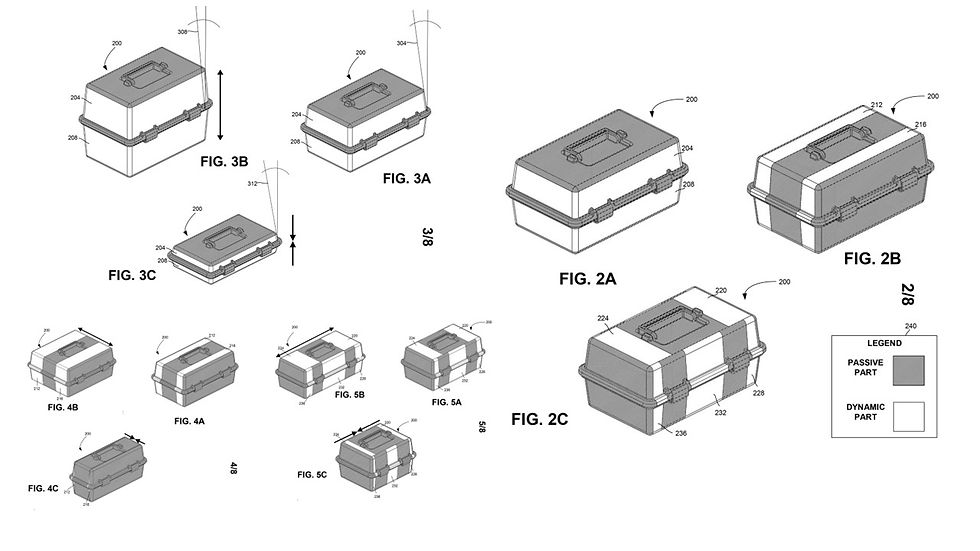
Now, what I realized is that you can always fix a few nuances here and there and resubmit again and again until the patent authority determines that your patent is indeed valid and innovative. But I was only interested in whether anyone thought about it and tried to implement it, because if someone thinks like me, it means that I'm not just wasting my time here. And of course, a few months after the filing, I got the answer from the patent authority with the verdict: yes, there were similar applications, and a lot of them. You can check the full list here. In a few words: some tried to patent the technology, the idea itself of moving and changing the size and form of the product (frames for glasses), some tried to patent the feature of moving parts on a product for customization and/or templates for a specific industry (Japanese tire protector patterns). That all meant only one thing - my project is valid; it is vital; it is needed. None of the mentioned had their own software with a specific feature for designers to make templates of their products and then a non-designer user using those templates scenario, like mine.
Although the list included one patent from the famous Dassault Systèmes software, it was not about Industrial Design Templates, but rather general about the solid way of making a 3D model with the so-called "feature tree," which I had to avoid or approach, and which I did.

Demo on the CGM 3D Engine (SolidWorks, CATIA etc.)
I reached out to Spatial, the well-known 3D engine developer from Dassault Systèmes, and they were super enthusiastic about my project. They invited me to chat about it in detail, and we explored how their tech could fit with my ideas. After our meeting, we set up a communication line that made collaboration easy, and I got access to a Core Geometric Modeler (CGM) for a month. This amazing tool helped me create a demo of my concept. I was really impressed by the CGM’s features for geometric computations, advanced rendering, and software integration. During the month, I ran several trials and got great support from the Spatial developers, who helped me navigate the CGM’s complexities. By the end, we put together a demo that showcased my original idea and highlighted Spatial's awesome technology.
In the demo, there wasn't any GUI—just a basic showcase of the 3D Template idea. You could resize or move the walls of the model/product using a simple slider bar. The area definitions and size limitations were handled through a TXT file, which is pretty typical for straightforward demos.
Conclusions
The downside of this impressive engine is the cost, which amounts to thousands of euros monthly, starting from the development phase and continuing after I begin selling, plus a percentage for every new customer. I quickly realized I needed to concentrate on my concept, and the professional engine could be useful later if this technology proves itself. I understood that I should avoid the infringing part of the "feature tree," thanks to the patent application results.
By this time, I was already working with Unity 3D, which was free for developers, and had built a functional app with 10 3D templates that exported to STL flawlessly. I 3D printed numerous tests, so I switched back to developing in Unity. I moved forward to an in-depth beta with a GUI for designers to create the 3D templates, write those templates in a format called TCO (TempCAD Object), and import them back into the app so users could exchange their designs. Important lessons were learned now the whole new chapter is calling.

Comments